November 18, 2026
I Built My Own E-Signature App in an Evening
Yesterday a new coaching client said yes, and I needed him to sign an agreement. For years I have sent my agreements through Dropbox Sign. I started using it when it was HelloSign, my friend Joseph Walla's company, and I stayed loyal to it from day one, through the acquisition by Dropbox, and after.
This time I asked Claude to build one into this site instead. It took about an hour of my prompting. The agents did the rest while I did other things, and that evening I sent the real agreement.
What it does
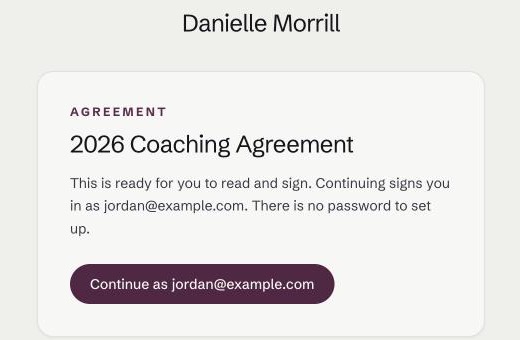
I write the agreement as a plain text file in my coaching repo. A script puts it on this site as a draft, and nothing goes out. I read the draft on my own page here, the way the client will see it. When I say send, the site emails the client a button that signs them in without a password. They read the agreement, sign with a finger or a mouse or a typed name, and download a PDF. We both get an email when it is signed.
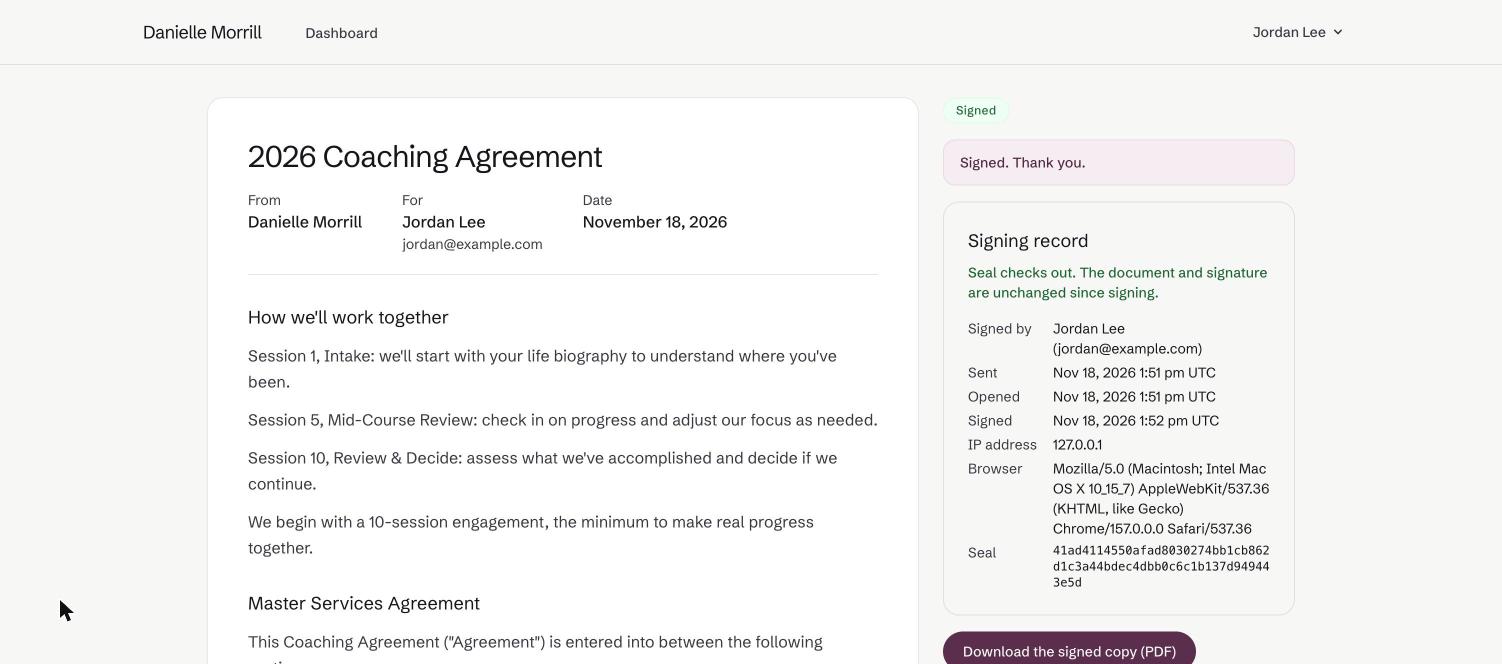
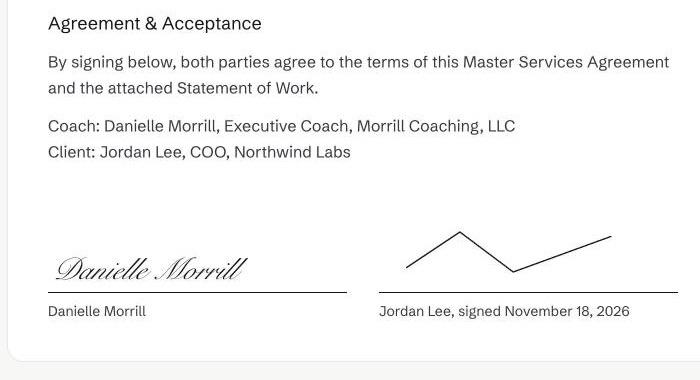
Behind my login, each signed agreement keeps a record of who signed, when, and from what address and browser. The record is sealed with a key only the server knows, so if anyone changes a word of the agreement or the signature afterward, the page says so in red.
That covers what I would have used a subscription for. It does not do multiple signers, signing order, templates with fields, or reminders. I don't need any of those yet.
Testing it on myself
I sent myself test copies before sending the real one, and each round turned up something.
The first test showed me the agreement had generic language where it should have said what the client and I talked about on our intro call. Claude rewrote that section from my call notes.
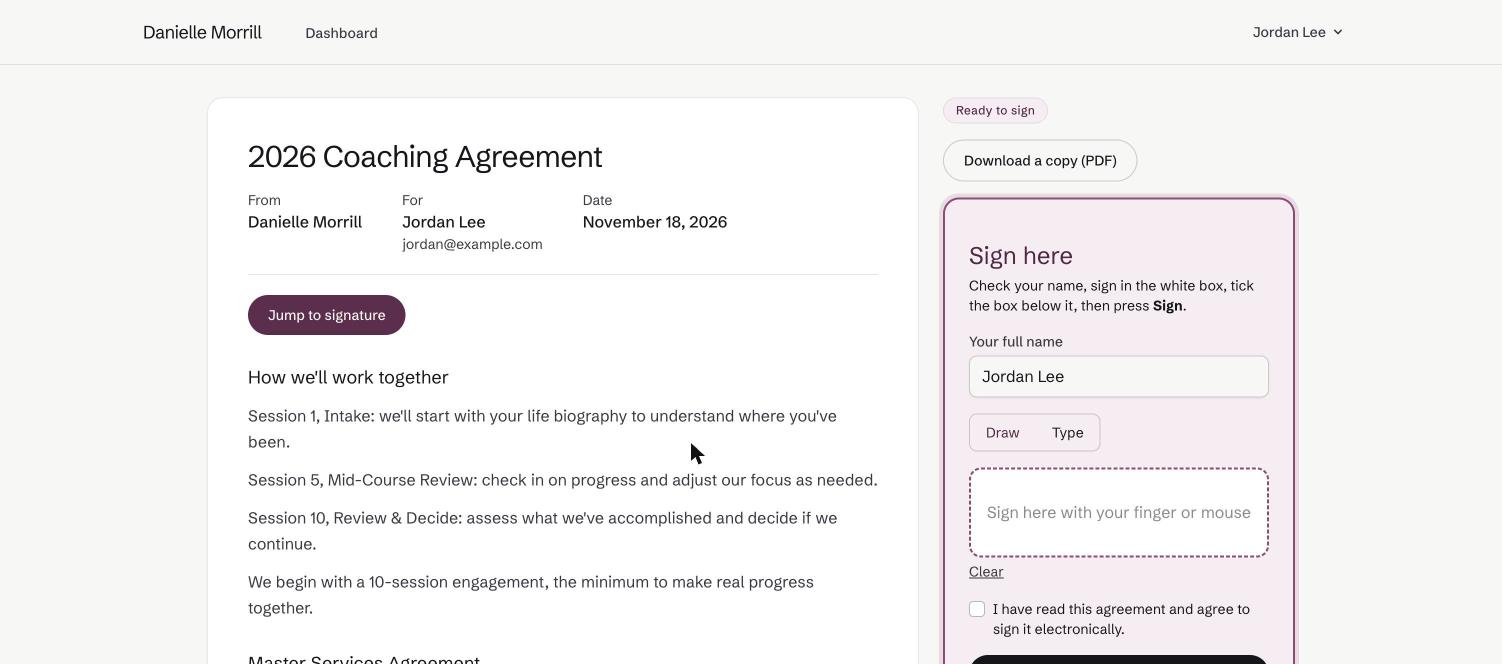
The second showed me the signature line at the bottom looked like a place to sign, but it was only a line. The actual signing box was off to the side, and on a phone it was below everything else. Now there is a "Jump to signature" button at the top, a "Sign here" button on the empty line, and the signing box has a colored border so you cannot miss it.
The third test I signed, and the page told me the seal did not match. Something in the record had changed after it was signed, seconds after I signed it.
The bug
This one I find interesting. The site's database stores the signature as JSON, and MySQL quietly rewrites the order of the keys in a JSON object when it saves it. So the signature that was sealed and the signature read back had the same contents in a different order, and the seal check failed on every signature.
The tests had all passed, because the tests run on a different database that keeps the order. Claude found the cause in a few minutes, wrote a test that copies what MySQL does, and fixed the seal to sort the keys first. The test fails on the old code and passes on the new code. Then it shipped the fix, and I signed a fresh test that checked out.
If I had paid for the software, I would never have seen a bug like this. It would have been someone else's problem.
What I think about it
I keep having this experience. Something I would have paid a monthly subscription for turns out to be an evening of work. My first reaction is that this is crazy. My second is to ask how much of the software I pay for I could replace this way.
Not all of it. Payments, email delivery, and anything where the vendor carries legal or security risk for me are still worth paying for. But a lot of SaaS is a form, a database, a PDF, and an email, priced as if those were hard to make. They used to be. For one person running a small practice, they mostly are not anymore.
Leaving Dropbox Sign after all these years feels a little disloyal. HelloSign made signing a document online easy long before anyone could build their own in an evening, and doing it for big companies, in many countries, with records that hold up in court, is still hard. I sign a handful of agreements a year, so I need much less than that.
The cost moved. I do not pay for the software, but I own it. When MySQL reorders my keys, that is my problem now, and I need agents and tests good enough to catch it. Yesterday they did.
I'm taking on new coaching clients
This is the kind of work I do with my coaching clients. Most of them are founders and executives who use AI every day and still feel behind. We start with how a real workday goes, get their tools sharing one memory and one set of rules, and then work on leading their team from there. Sometimes that means building small tools like this one together.
I have room for a few new clients. If that sounds like you, tell me a little about what you are working on.
You can read more about how I work on my coaching page.