cooking / breads
Grandma Morrill's Cinnamon Rolls
Kevin's grandmother made cinnamon rolls. Nobody has her recipe card. I baked version one, he tasted it, and he remembered the thing we were missing.
serves 6 rolls · overnight, plus about 2 hours in the morning · 70 minutes hands on · hard
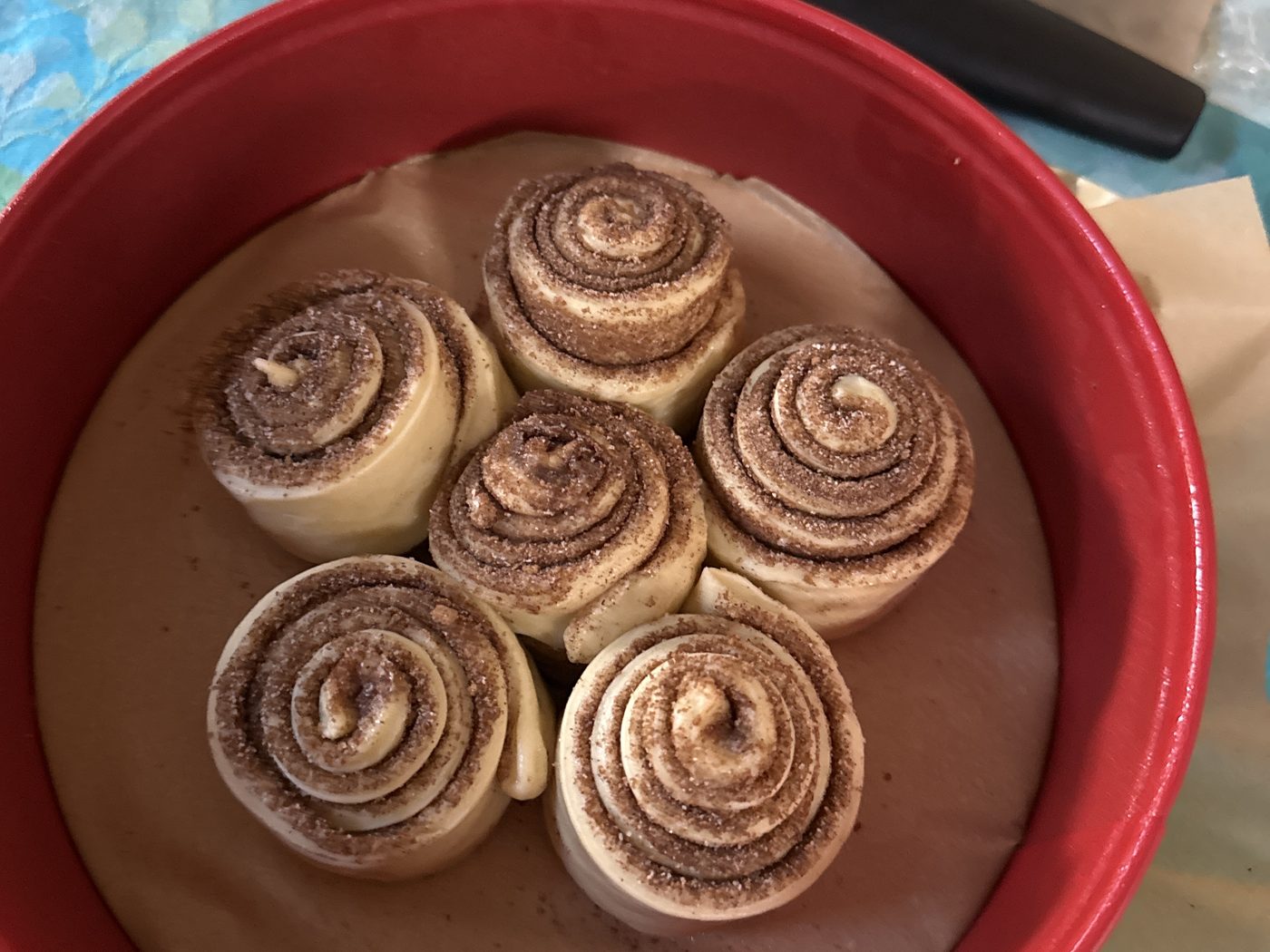
Kevin's grandmother made cinnamon rolls. Nobody in the family has her recipe card. All I have is his description of eating them.
I built this recipe from the description. I baked the first version on August 24 and gave one to Kevin.
Tasting a real roll got far more out of him than asking him to describe one from memory ever did. He remembered something that was never in the original description: there was cinnamon sugar on the outside of the roll. He thinks she rolled each one in cinnamon sugar after shaping it.
That one technique explains three separate things he had said. Hers were sweeter, but he was clear the dough itself was not sweet, and sugar on the outside reads as sweetness without touching the crumb. Hers were browner, and sugar on the surface caramelizes far harder than any wash. And he always said there was no part you didn't want to eat, which makes sense if the outside is not plain bread.
The recipe below includes it. I have not baked that version yet. The next one is October 18.
What I am trying to match
- Cinnamon sugar and butter between very thin layers, with the layers staying separate.
- Layers about as thick as a pinky finger.
- About six swirls in a roll.
- Very dark on top. Not golden.
- Moist all the way through, with no frosting.
- No frosting, no glaze, no nuts, no raisins.
- No puffy bread ring on the outside. The outer layer looks like all the others.
- He said there was no part you didn't want to eat.
He added more after tasting version one:
- Cinnamon sugar on the outside, on the outer wrap and the last twist.
- Sweeter overall, but the dough itself was not sweet.
- Flat and even across the top. Not domed.
- She rose the dough in the oven with a towel over it. He does not know if the oven was on or if it was just the light.
The warm rise settles a question he raised himself. He wondered if she used baking soda instead of yeast. She didn't. A dough leavened with soda or powder has no reason to rest somewhere warm, because it starts working the moment it hits liquid. A warm rise under a towel is a yeast technique.
When the recipe and the description disagree, I follow the description.
Ingredients
Half batch, six rolls, 8x6 pan. Weigh everything.
Tangzhong
- Bread flour, 20g
- Water, 105g
Dough
- Bread flour, 250g
- Granulated sugar, 33g
- Fine sea salt, 5g
- Whole milk, 30g
- Neutral oil, 25g
- Large egg, 1
- Active dry yeast, 2.5g
Filling
- Unsalted butter, 58g, softened
- White granulated sugar, 40g
- Light brown sugar, 40g
- Ground cinnamon, 1 Tbsp
For the outside
- Granulated sugar, 50g
- Ground cinnamon, 1 tsp
Mixed in a shallow bowl, to roll the shaped rolls in. Make more than you need so there is a bed deep enough to roll in. No wash of any kind goes on top.
For a full batch of twelve, double everything.
Equipment
- Digital scale
- Stand mixer with the flat beater and the dough hook
- Rolling pin, and about 30 inches of clear counter
- Ruler
- Unflavored dental floss
- Bench scraper
- 8x6 pan, or anything that holds six rolls tightly
- Rimmed sheet pan
- Instant-read thermometer
Method
Evening
- Whisk the 20g flour and 105g water smooth in a small pan. Cook over medium heat, whisking the whole time, about five minutes, until it thickens into a paste that holds a line from the whisk. Weigh the pan before you start and again after. It should come out at 125g. Whisk any lost water back in while it is hot. Spread the paste thin on a plate to cool.
- Warm the milk to 105°F. Stir in the yeast and a pinch of the sugar. Leave it five minutes until it foams.
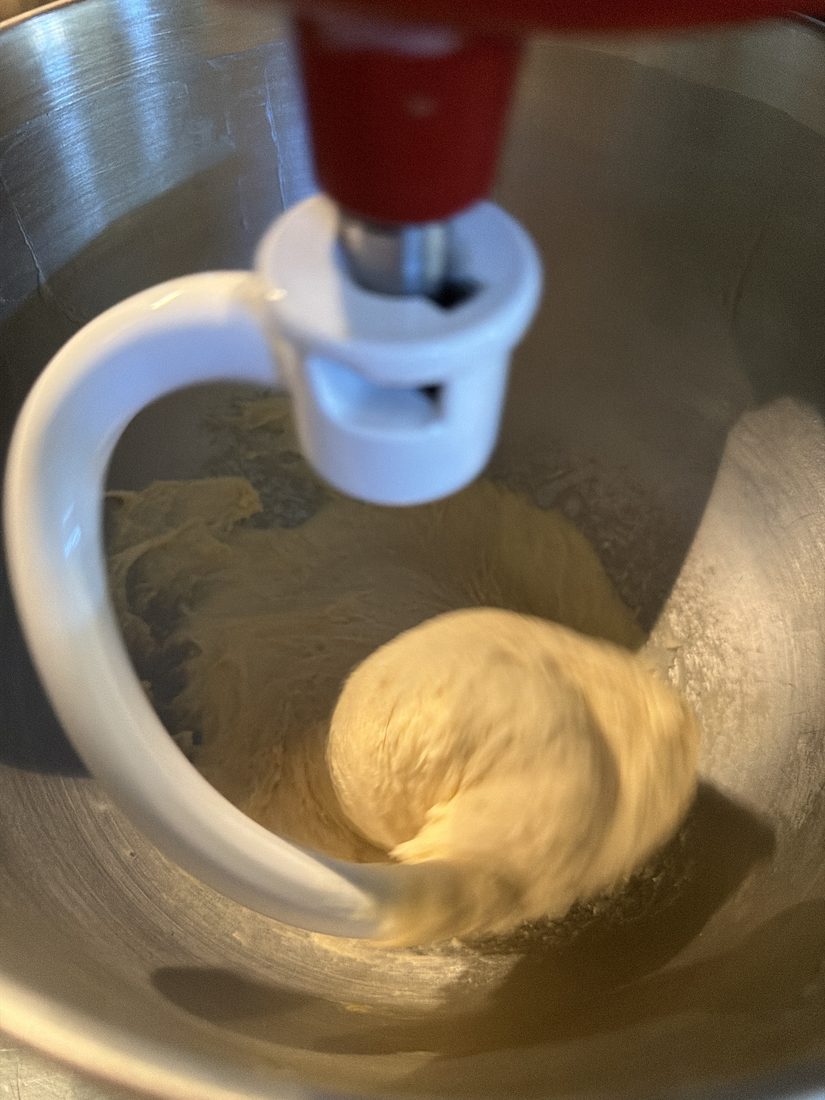
- Put the flour, sugar, salt, egg, cooled tangzhong and bloomed yeast in the mixer bowl. Keep the salt and the yeast apart until they are mixed in. Run the flat beater on low until there is no dry flour, then stream in the oil. Switch to the dough hook.
- Knead on speed 2 for six to eight minutes. Stop and scrape the dough back onto the hook a few times. A batch this small rides up the side of the bowl. Stop when a pinched piece stretches thin enough to see light through before it tears. A small tear at the edge is fine on an enriched dough.
- The dough should feel slack and tacky. If it feels stiff, add water 5g at a time. Do not add flour.
- Cover with plastic wrap and let it rise 60 to 70 minutes, until it is up about half again. Not doubled.
- Press the dough into a rough 1-inch slab on a sheet pan, cover, and refrigerate. Forty minutes is enough to roll it. If you want to bake in the morning, leave it here overnight, 8 to 14 hours, and do everything below the next day. Do not shape and coat the night before. Sugar sitting on buttered dough for twelve cold hours dissolves into syrup and you lose the coating.
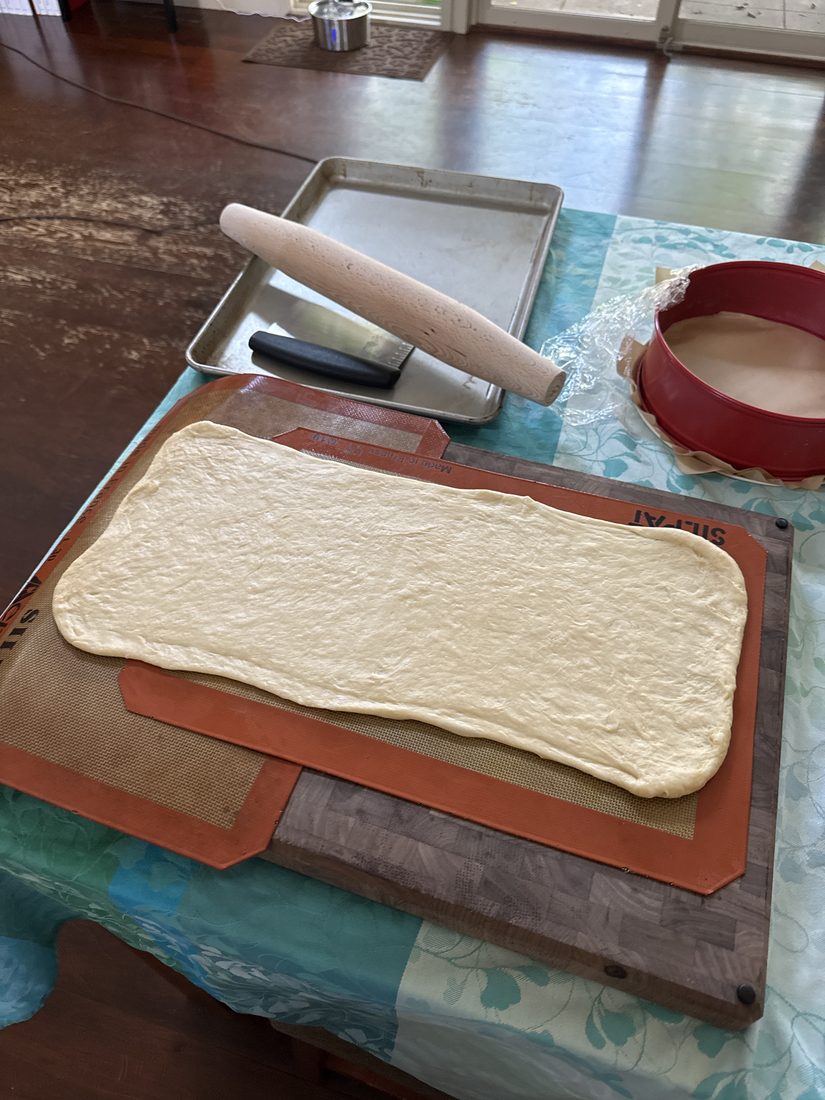
- Roll the cold dough to 24 inches long, 6 inches wide, 3/16 inch thick. Measure it. Roll from the center out to each end, then square the corners with the bench scraper. If it springs back, rest it five minutes. If it turns sticky, put it in the fridge for ten.
- Spread the butter over the whole sheet in a thin film, all the way to the edges. Mix the two sugars and the cinnamon and sprinkle the mixture over the butter, dry. Do not cream the sugar into the butter.
- Cut six strips lengthwise, each 1 inch wide and 24 inches long. Use floss. Slide it under the sheet, cross the ends over the top, and pull.
- Roll each strip up tight from a short end and tuck the tail underneath. Count the swirls on the first one. You want about six. If you get four or five, roll the rest of the strips thinner before shaping them.
- Roll each shaped roll on its side through the cinnamon sugar so the outside picks up a coat. The surface is already tacky with butter, so it takes the sugar without anything to help it stick. Do not coat the cut faces.
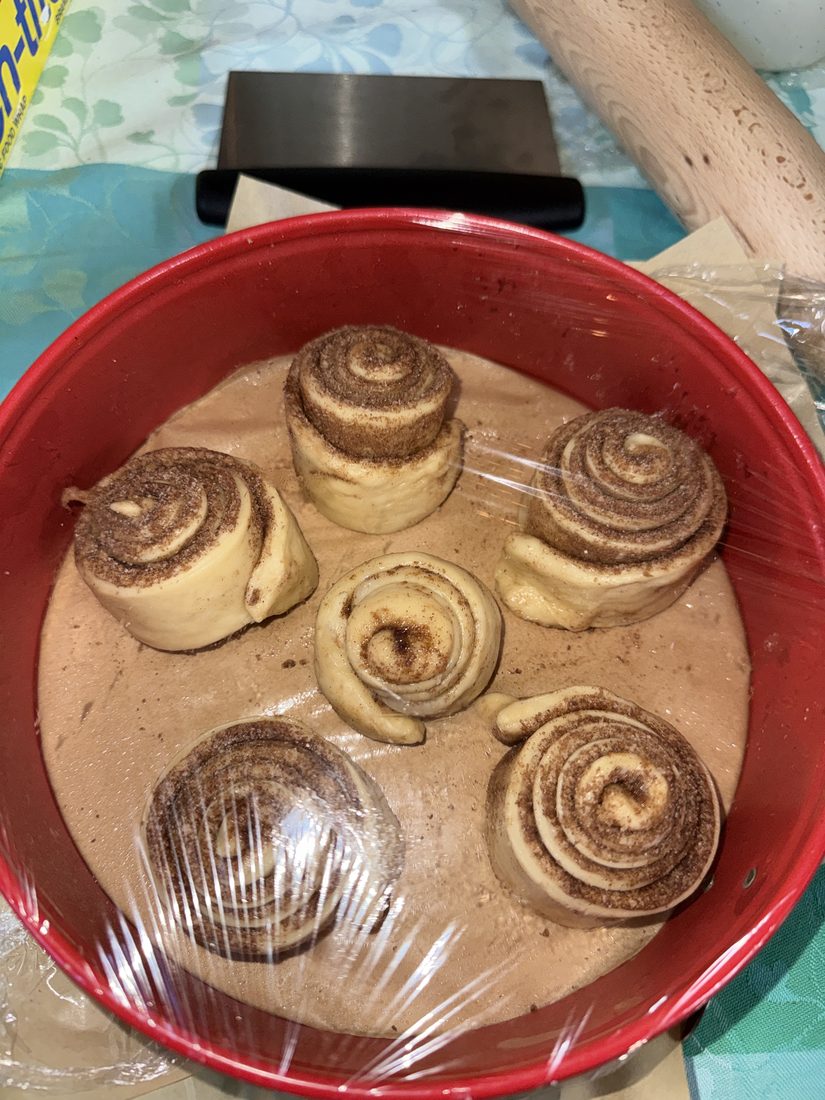
- Put them cut side up in the pan, packed tight. They should be touching, or nearly. Bake them now, or cover and go straight to the rise.
The rise, then the bake
- Cover with a towel and put the pan in the oven with the oven off and only the light on. Leave it 60 to 90 minutes. You want puffy and springy. A poke should come back slowly and part of the way.
- Take the pan out, then heat the oven to 365°F. It needs 15 to 20 minutes. Do not preheat while the rolls are still in there.
- Bake 26 to 30 minutes on the sheet pan. No wash. The sugar on the outside is what browns them, and brushing anything on would dissolve it.
- Bake for color, not for time. Go past golden to dark. Color decides when they come out, not the thermometer. If they read 190°F and the top is still pale, keep going.
- Pull them at 190°F or above, once the tops are genuinely dark. Cool ten minutes in the pan.
- Do not glaze them. Do not butter the tops.
Why 24 inches
This is the part that decides everything else.
Most cinnamon roll recipes have you roll a 16-inch rectangle and slice the log. That gives about four fat turns and leaves a plain flap of dough wrapped around the outside. The flap is the puffy ring Kevin does not remember. Rolling to 24 inches and cutting strips lengthwise means I pick the number of turns instead of taking whatever the log gives me.
If you scale this recipe, change the width of the sheet. Leave the length at 24 inches and the thickness at 3/16 inch. A sheet with both dimensions halved comes out looking fine and is wrong.
Version one confirmed this part. I got about five turns and no plain flap on any roll.
One caveat I only learned after. Kevin remembers cinnamon sugar on the outside, and a coated roll would not look like plain bread even if a flap were there. So the outer ring is no longer the only evidence for the 24 inches. The six swirls and the thin layers still need it.
Why the pan is small
Kevin remembers them flat and even across the top, not domed. That is a packing question. Rolls crammed against each other can only go up, and they press each other square until the pan reads as one surface. Rolls with room around them dome individually and let the melted butter run out between them.
Version one used a 9-inch round and they had gaps. A 9-inch round gives about 10 square inches per roll. The 8x6 gives 8, and a finished roll covers about 7. Tight is the point.
Why there is a tangzhong
The rolls have to be moist with nothing on top of them. Cooking a little of the flour with water first lets the dough hold more water and keep holding it. It is also what makes it safe to bake them as dark as the description calls for.
A grandmother in that era would more likely have used mashed potato or scalded milk. I want to try the potato version next, and there is now a better reason than period accuracy.
Kevin thinks she rose the dough once as a single lump, then rolled it, cut it and baked it right away. This dough cannot do that. The tangzhong makes it slack on purpose, and the overnight chill is there only because it is the one way it rolls to 3/16 inch without fighting back. A stiffer potato dough is the kind you can roll warm off one rise. If his memory is right, the tangzhong is not just a different choice. It rules her method out.
Notes
Altitude. I cook at 5,280 feet in Denver. The yeast is down to 2.5g for that reason and both rises run short. The oven is at 365°F instead of 350°F. Judge every rise by looking at the dough, not by the clock. Over-proofing is the failure this recipe is most likely to hit, and it merges the layers.
Dry air. Weighing the tangzhong before and after cooking is the fix most worth doing here. It reduces further than the recipe expects and quietly lowers the hydration of the whole dough. Cover dough with plastic wrap and not a towel. In dry air a towel pulls moisture out. The exception is the rise in the oven, where the box holds its own moisture and a towel is fine.
Storage. Cool them all the way, then store airtight. Bagging them warm steams the crust soft. Reheat at 300°F for five to seven minutes. A microwave ruins the layers.
What I got wrong the first time
I put the dough in the fridge before the first rise instead of after. Cold dough barely ferments, so nothing happened. I took it back out and let it rise on the counter.
The rise was slow and I nearly threw the batch out. I checked the underside of the bowl and there were bubbles, which meant the yeast was working and the dough was just cold. I boiled a mug of water in the microwave, pushed it to the back, and put the covered bowl in with the power off. It came up in 40 minutes.
I was waiting for the dough to double. Doubled is too far for this recipe. Half again is the target.
I rolled the dough out on a silicone mat. The mat is 16 inches long, so the sheet could not reach 24 inches, and the raised border kept the pin off the edges. I moved to the counter.
I added the yeast dry, mixed in with the salt. Salt sitting against yeast pulls water out of it. Next time I bloom the yeast in the warm milk and keep the salt on the other side of the bowl. That is how the recipe above is written.
How version one came out
The layers worked. Distinct bands of cinnamon and dough in every roll, about five turns, no plain flap.
The color did not. They came out barely golden against a target of very dark. The cause was in how I pulled them. The recipe gave two signals, color and temperature, and assumed they arrive together. On rolls this size they do not. The centers hit 197°F while the tops were still pale, so I followed the number and the bake ended before the browning did. The recipe above now says color decides and temperature is only the floor.
I also had no cream and used whole milk, which browns less. That contributed. It does not explain a gap that size.
The proof was short. They went in under and never grew into each other, so there were gaps between them and a lot of butter ran out onto the pan.
Kevin said they were chewy and read as underbaked to him. Three things could cause that and all three were true at once: underbaked, under-proofed, and made with bread flour. The first two are fixed in the recipe above, so the next bake tests them for free. If they are still chewy after that, it is the flour, and I will try all-purpose.